SmartSDR v4.2.20 | SmartSDR v4.2.20 Release Notes
SmartSDR v3.10.15 | SmartSDR v3.10.15 Release Notes
The latest 4O3A Genius Product Software:
The latest 4O3A Genius Product Software and Firmware
If you are needing assistance with FlexRadio products, please refer to the product documentation or check the Help Center for known solutions. Need technical support from FlexRadio? It's as simple as creating a HelpDesk ticket.
FreeDV Docker container for 8000/Aurora series

Hi all,
I'm one of the developers on the FreeDV project. I mentioned this on a FlexRadio related mailing list but for those who haven't seen this yet, I wanted to make you aware that there is now a Docker container available that you can install onto your Flex 8000 or Aurora series running the most recent version of SmartSDR. To set this up:
- Download the Docker container from https://github.com/drowe67/freedv-gui/releases/download/v2.3.1/freedv-waveform-2.3.1.tar.gz (Current version: 2.3.1, released today.).
Note: do not decompress the .tar.gz file. SmartSDR needs the file as-is in order for the FreeDV waveform to properly function. - Go to File→Waveforms in SmartSDR. You'll see something like the following:
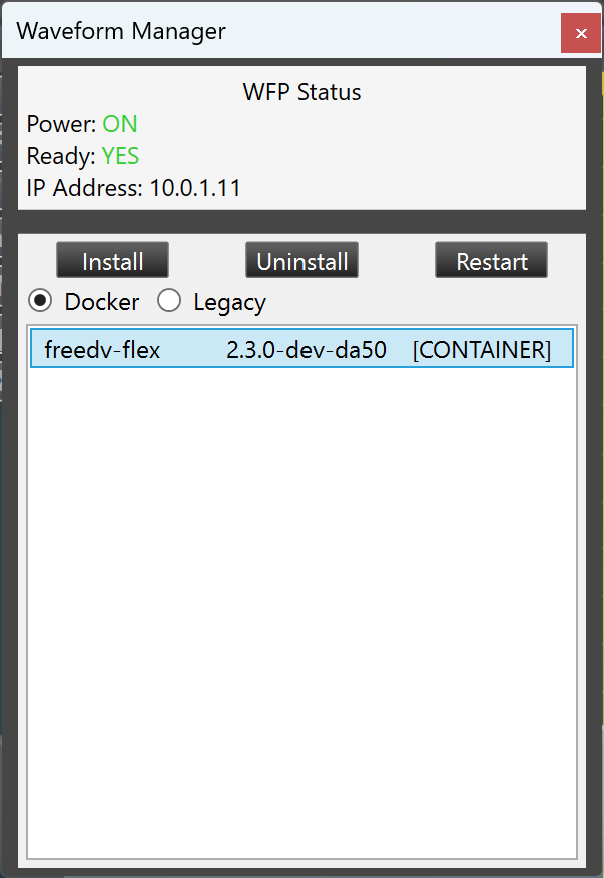
- Click on the "Docker" radio button and then click Install. When prompted, choose the .tar.gz file you downloaded above.
- The Install button will change to "…". Once it finishes installing the Docker container, the label will become "Install" again and there will be a new "freedv-flex" entry in the list. "FDVU" for FreeDV on Upper Sideband and "FDVL" for FreeDV on Lower Sideband modes will then become available for use in SmartSDR.

Operation in SmartSDR is similar to operating in regular voice modes with a few differences:
- DAX should NOT be enabled for the slice using FreeDV. Otherwise, no TX audio will go out.
- The FreeDV waveform can only be used on one slice at a time. Attempting to use it on more than one slice will cause the waveform to switch other slices back to regular USB or LSB modes. (Note: it is possible to use the FreeDV application on a second slice without interfering with the waveform.)
The waveform/Docker container also supports FreeDV Reporter and will connect to that server when you set the active slice to FDVU/FDVL. This is particularly useful for seeing who's currently on FreeDV and how propagation is doing (for instance, rows will immediately light up in blue when they're decoding a signal).
Anyway, hope you guys enjoy! Feel free to comment with questions or feedback :)
Thanks,
-Mooneer K6AQ
Comments
-
Ive downloaded the file following your directions. it doesn’t show up in the waveform manager. where should that file go so it will?
0 -
It should appear as soon as you select the downloaded file in the window that comes up when you push the Install button. Does it come up if you restart the radio?
0 -
Very nice, Mooneer! This will make FDV much more accessible.
73,
Dan0 -
Mooneer, is there a step I'm missing when installing the container in SmartSDR v4.2.18? I went to File → Waveforms like you indicated:
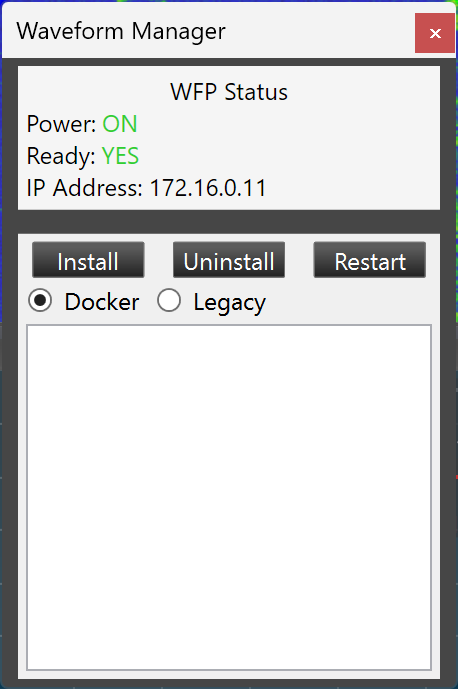
I clicked Install and pointed it at the freedv-waveform-2.3.1.tar.gz I downloaded from the Github repository. The Install button changed to a grey button with progress dots like this:
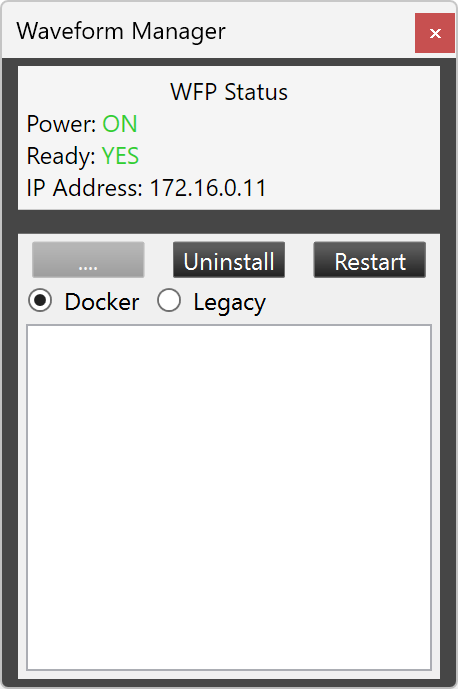
After about 30 seconds, the button changes back to a normal Install button, but nothing is added to the list below. No error message was generated. I tried with the 2.3.0 release and got the same results. I also tried restarting SmartSDR and my 8600 multiple times, but always with the same result.
Is there an installation log created somewhere?
Thanks and 73,
Don, K4PEZ
0 -
Don, I heard of a similar problem from someone else and Flex support ultimately had them reinstall the OS on the radio (factory reset wasn't enough). You may need to contact support to see if you need to do that as well.
-Mooneer K6AQ
0 -
I downloaded and installed the FreeDV 2.3.1 Docker in my 8600 this morning. No issues with the install and I monitored 14.236 for a couple of hours and was impressed with the audio quality of FreeDV.
Could someone who has mastered TX setup post some hints. I assume mic processing should be off. How do you set Mic Gain? Should voice peaks be close to "0" on the Level meter? Any other settings to consider?
Thanks/73,
Pat, W5VY
0 -
Pat: Basically, I just make sure that the peaks are a bit under the "0" on the Level meter. FreeDV is particularly sensitive to overdriving your microphone, so you definitely want to avoid that where possible.
-Mooneer K6AQ
1 -
Installed FreeDV and actually had a nice conversation with several people on a net here in Texas on 40 meters. Audio clarity was really surprising. Several out of state hams joined in as well. I was using SmartSDR on my pc. But, I later noticed that people's callsigns were showing up on the front panel of my AU-520M! I existed SmartSDR on my pc and found that FreeDV was selectable in the Mode Selection menu on the radio. I never knew it was there.
A fun new mode to play with. Thanks to the develops that made it possible
James
WD5GWY
0 -
It looks like the processor should be off and as reported above, definitely keep the audio level below 0 dB. I have had several QSOs on 20 and 40 meters now, and it is working really well. One thing to note - you cannot have more than one slice on FreeDV at a time. This includes during a multiFLEX session. If you are on FreeDV and your multiFLEX buddy opens a slice on FreeDV, your slice will move to USB or LSB depending on band.
1 -
I noticed that! I was using FreeDV on my pc with SmartSDR and after seeing the callsigns show up on the radio's front panel, I wondered if FreeDV was selectable on the radio. I found it listed under "Other " in the Mode selection menu. But, I got a error message saying only one instance of FreeDV can be running.
What I don't know, was FreeDV installed with the latest version of SmartSDR? Or did it somehow get installed on the radio when I downloaded it and installed it from the Waveform menu in SmartSDR on my pc? Either way, it's a really nice Mode. Much better than some others I have tried.
James
WD5GWY
0 -
Trucker,
To get the FDVU and FDVL modes to show up on the Radio itself you need to have A Raspberry Pi or Computer on the same network as the Radio running FREEDV-FLEX Waveform for ALL 6000 and 8000 Radios or on the 8000 series you can run the FREEDV-FLEX DOCKER waveform right on the Radio itself.
The Problem with the Docker Waveform so far is the lack of the ability to add your Grid Square, Name, QTH and other information for the FREEDV-Reporter
For the Pi FreeFV-FLEX version you can add the information line to the same command line that you use to start the FreeDV-FLEX program on the Pi.
These work with what ever software or console you are running, Maestro, AetherSDR, SmartSDR, RimuSDR, MAC, Not sure about the IOS as I haven't tried that yet but it should.
If you run AetherSDR you can also use the RADE MODE that is built in.
0 -
I do believe you are incorrect as far as the 8000 and Aurora radios go. I operated the radio standalone using FreeDV without any external Raspberry Pi. This was after using it with SmartSDR on my pc. It worked just as well as it did in SmartSDR.
James
WD5GWY
0 -
Listening on 14.236 no computer connected. Working fine.
James
WD5GWY
0 -
Bret, my apologies. I think that I misunderstood your comments. As I understand it, FreeDV is in the latest release of SmartSDR for the 8000 and Aurora radios. At least on my AU-520M it was there without me having to do anything. At first I thought it was installed to the radio when I downloaded the gz file to my computer and then selected it from the Waveform menu selection in SmartSDR. I had thought that it not only got installed on my computer, but also to my radio. I read a post from Mike on groups.io mailing list that leads me to believe that it was already installed in my AU-520M.
James
WD5GWY
0 -
Answering my own questions. The latest release of FreeDV does have the ability to upload FreeDV to the 8000 and Aurora radios. Here's a quote from the developer.
FreeDV 2.3.0 has just been released, and with this comes the ability to upload FreeDV to your Flex 8000 or Aurora series radio using the Docker container feature that is new with SmartSDR 4.2.18! This allows you to use FreeDV with your Flex radio in a manner similar to what you would do with regular USB or LSB modes; no need to set up DAX or CAT with the FreeDV application (though you still can do so if you'd like).0 -
BTW I received some reports that TX with the waveform on the Aurora series doesn't work properly unless you set TX low/high cut to 0 and 8000, respectively. This change isn't needed on the 8000 series (or 6000 if using the AppImage on a Raspberry Pi).
0 -
8600 4.2.20 Windows 11 Pro, FreeDV audio RX not working with Docker, TX audio is OK
Rig works fine with FreeDV 2.31 App using CAT/DAX
Any thoughts on a fix appreciated
Thanks
0 -
I know that Mooneer has been working on the RX audio issue and has a fix for it for at least the 8600 and have it taken care of, something else with the Docker is that the Call sign and SNR of the Received SNR is very intermittent, On just the Aurora SmartSDR has a problem with the RX filters and instead of running the filters at 750-2250 that you have to run them wider for it to work properly.
0 -
Re: call sign decode--is this in comparison to the FreeDV application, or a previous version of the Docker container/AppImage? Which versions exactly?
0 -
I'm running DOCKER "freeDV-flex dev 2.4.0 b7cb", I'm not sure what "call sign decoder" is at least I haven't seen that as a DOCKER file.
0 -
I was referring to whether the FreeDV application itself seemed to be decoding more consistently than the version of the Docker you're using.
What happens if you use version 2.3.1 of the Docker container? Any improvement in how often call signs are decoded?
0 -
Oh yes the Application does decode better as does the Pi FreeDV-FLEX AppImage decodes call signs better than the DOCKER Does.
The older version pre-2.3.0 DEV Docker decoded Callsigns better and had better RX audio then on the 2.3.0 release, and the "2.4.0 dev" up to the dev version DOCKER "freeDV-flex dev 2.4.0 b7cb" Mooneer sent me.
0 -
This is actually K6AQ here :)
Anyway, I'm hoping that maybe this version of the Docker container will decode callsigns a bit better (GitHub account required to download). Available as AppImage here too if preferred. The fix in this build would likely apply more for signals with higher SNRs, though.
Re: audio quality, to make sure I understand your last comment, 2.4.0 b7cb still had worse audio quality than pre-2.3.0? Or is it on par/better?
***
1_Flex_newbee.1: A few things to rule out anything obvious:
- Do you still have issues even after a radio reboot?
- Any difference if you choose FDVL vs. FDVU? (i.e. does one work but not the other?)
1 -
No audio quality on 2.4.0 b7cb had good audio and I did not see any difference between FDVL or FDVU decoding.
there was no difference after a reboot with the call sign Decoder.
This is all with the Docker 2.4.0 dev b7cb
The only issue I saw with Docker 2.4.0 dev b7cb was the Call sign Decoder and once having it on for 3 or 4 days my TX audio became Distorted and un copyable, and I just had to restart the Docker to get the TX clean audio back.
I will give the link you sent a try and see if it works differently.
Thanks so much
73
0 -
The Docker 2.4.0 dev d066 receive audio sound is kind of muffled it started out really good and gradually after a few minutes got worse the longer it was on, so far the Callsign Decode never did decode a Call sign.
I think d066 is worse than b7cb was and I think b7cb works better all around.
Thanks for letting me test this version
This is on a Flex8600
73
0 -
To “themindiswatching” K6AQ
Thank you for responding. 1) Yes, 2) No difference.
I am beginning to wonder if signals were too poor on the occasion I used it. Next opportunity is a .au Sunday Net if I can make it. I have a rather poor 40m antenna in a suburb location!I wonder is there perhaps a ‘test file’ I could try similar to one in the FreeDV app for testing decodes?
🤓John
0 -
WX7Y: I was investigating some more and it looks like some of the problem is that the packet at the end of the transmission is being cut off when SmartSDR goes from TX to RX. No valid packet = no callsign decoded at the other end. I also fixed some memory leaks that I found but not sure if those are the cause of the audio slowly degrading over time.
Anyway, this Docker container adds additional time before the radio switches from TX to RX in FDVU/FDVL. If nothing else, more stations should be able to decode you given a high enough SNR (I'd say >= 3dB according to FreeDV Reporter but you may still be decoded by other stations 1-2 dB below that). Unfortunately I think this issue may also apply to the regular FreeDV application but I'll need to do more testing on that end to confirm.
***
John: What I've done before is to transmit using the FreeDV application and a second radio plugged into a dummy load. At QRP power it's still enough for my regular station antenna to pick up, thus the waveform is able to decode. If that's an option for you, it's worth a try to make sure the waveform itself is working. You can also have a second slice on DIGU/DIGL and set up with DAX/CAT for the FreeDV application; if that's able to decode but the waveform slice is not, that would indicate an issue.
0 -
with the limited activity activity on the band and I was in and out of the shack but the stations I could hear sounded good but there was still no decoding of the callsigns or SNR.
I think if I get some more time I will do a hard reset and reload the latest Docker you sent and see if that helps
Thanks for your work on this great project.
73
Bret WX7Y
0 -
Sorry I am new to this and a bit confused as to who replied. I think it was K6AQ.
Thank you for the suggestion. I was told that my Tx audio is clear no problem by local Hams.
I have since discovered when using WSJTX and trouble shooting no decodes, despite a full waterfall, that my computer clock was way out of sync! Once I dealt with that decodes came flooding in!
I am wondering if this could have anything to do with my RX audio using Docker?
John0 -
No the Docker is in the Radio itself, your computer time clock is in the computer itself.
There are a few free computer programs that can be run in the background that keep your computer clock correct. is what I use here.
0





Leave a Comment
Categories
- All Categories
- 401 Community Topics
- 2.2K New Ideas
- 691 The Flea Market
- 8.6K Software
- 197 SmartSDR+
- 6.6K SmartSDR for Windows
- 200 SmartSDR for Maestro and M models
- 462 SmartSDR for Mac
- 280 SmartSDR for iOS
- 268 SmartSDR CAT
- 220 DAX
- 395 SmartSDR API
- 9.6K Radios and Accessories
- 113 Aurora
- 352 FLEX-8000 Signature Series
- 7.2K FLEX-6000 Signature Series
- 999 Maestro
- 58 FlexControl
- 872 FLEX Series (Legacy) Radios
- 978 Genius Products
- 484 Power Genius XL Amplifier
- 358 Tuner Genius XL
- 136 Antenna Genius
- 323 Shack Infrastructure
- 228 Networking
- 485 Remote Operation (SmartLink)
- 147 Contesting
- 847 Peripherals & Station Integration
- 148 Amateur Radio Interests
- 1.1K Third-Party Software