SmartSDR v4.2.20 | SmartSDR v4.2.20 Release Notes
SmartSDR v3.10.15 | SmartSDR v3.10.15 Release Notes
The latest 4O3A Genius Product Software:
The latest 4O3A Genius Product Software and Firmware
If you are needing assistance with FlexRadio products, please refer to the product documentation or check the Help Center for known solutions. Need technical support from FlexRadio? It's as simple as creating a HelpDesk ticket.
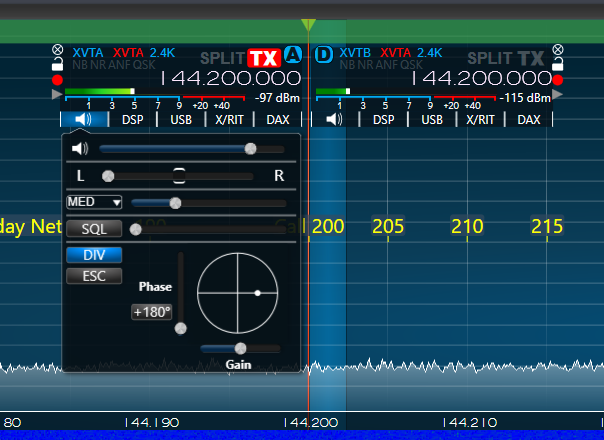
Diversity receive enablement removes primary slice antenna (label)

anyone else seeing this? I opened a ticket just now.

I still get audio from that slice, but it doesn't say ANT1 for the primary Recv antenna after clicking on diversity. When I click off of diversity, it's still not labeled.
I can click on ANT1 when I see it blank and it stays
Comments
-
…same story here… and since ESC is on your pic > it has still no function… + some other minor bugs… but at least this version works on my Flex6600 and W11pro…
73 Hel, OE8TTR
0 -
I agree, ESC seems to be exceptionally unintuitive or it doesn't work. I can figure out most things, but ESC eludes me entirely.
0 -
Hi Hel and Mike,
I've been frustrated with ESC as well but I actually got it to work on two different signals yesterday evening. I hadn't been able to before the .2 update but even that may have been down to some confusion.
There are three different "flavors" of "diversity reception" (I've heard a variety of different terms used for all of this). The one Flex has been providing with their "DIV" takes advantage of the fact that antennas spaced sufficiently far apart, or of different types "hear" signals differently. The classic case is one with vertical polarization the other horizontal resulting "polarization diversity". You receive them independently and feed the audio resulting from one to one ear, the other to the other (note that you don't sum them). Technically speaking the signals are different due to phase and amplitude. The result is most "QSB" (for example that resulting from Faraday rotation) gets turned into the signal appearing to move across the audio field, and/or signals that would have normally been on top of each other now being separated "spatially". I've always said it's the most under appreciated "thing" in ham radio. It's amazing.
The other two are "nose mitigation" and "beam steering". Both require antennas suited to the purpose. For the first, one is chosen to be as noisy as possible, the other your normal receive antenna (which is also picking up the noise the first is hearing but is doing a better job of hearing the desired signal too). The first is summed with the second, and gain and phase difference are adjusted until the noise from the first cancels the noise in the second leaving just the signal. There are commercial boxes that do this like the Timewave ANC-4. How well this actually works depends on, well, everything.
Identical antennas are used for the final beam steering case. Here they're also summed, phase is adjusted (and gain if necessary) resulting in the combination of antennas acting like a single antenna with adjustable directionality. It's literally what multiple element antennas are doing (but in a fixed sense) to achieve directionality. It's the principle behind steerable phased arrays. There are also commercial boxes that do this like the DXE NCC-2.
Notice the later two cases require specific types of antennas and do their trick by phase coherently summing them to a single signal. I think there may be confusion that Flex's ESC function isn't working because folks are expecting something similar to DIV with the ability to move signals around in the "stereo" audio field. Technically, that's possible but it's not what ESC is doing and I'm not sure it's of much use anyway. The last two cases and what ESC is doing result in a single summed mono signal.
I've been assuming that even with my antennas (chosen for the first polarization diversity case - one is a vert, the other a dipole), most signals would be enough different in phase as seen by them that ESC would reveal differences when adjusted but I could never find a case where that happened before v4.2. Yesterday I found two unambiguous, repeatable cases (yucky carrier messes) so I see that ESC does work. But its purpose is to implement cases two and three above, the existing DIV function already takes care of case one (beautifully). Until I set up appropriate antennas to implement cases two/three I don't expect anything useful to result from ESC because that's using it improperly. And what I am seeing is that signals do not appear different enough in my antennas (and maybe others) to result in much difference when summed. Surprised a bit, but that's what's happening.
Anyway just some thoughts. Hope their useful,
Russ KR6W
2 -
0
-
Same here the one antenna label will black out, but I can click back on it and it will turn back on.
Brett W5BLF
0


Leave a Comment
Categories
- All Categories
- 401 Community Topics
- 2.2K New Ideas
- 689 The Flea Market
- 8.6K Software
- 196 SmartSDR+
- 6.6K SmartSDR for Windows
- 200 SmartSDR for Maestro and M models
- 460 SmartSDR for Mac
- 279 SmartSDR for iOS
- 268 SmartSDR CAT
- 220 DAX
- 395 SmartSDR API
- 9.6K Radios and Accessories
- 109 Aurora
- 348 FLEX-8000 Signature Series
- 7.2K FLEX-6000 Signature Series
- 999 Maestro
- 58 FlexControl
- 872 FLEX Series (Legacy) Radios
- 975 Genius Products
- 482 Power Genius XL Amplifier
- 358 Tuner Genius XL
- 135 Antenna Genius
- 321 Shack Infrastructure
- 226 Networking
- 483 Remote Operation (SmartLink)
- 145 Contesting
- 847 Peripherals & Station Integration
- 147 Amateur Radio Interests
- 1.1K Third-Party Software