Welcome to the FlexRadio Community! Please review the new Community Rules and other important updates on the Message Board.
The latest SmartSDR Software:
SmartSDR v4.3.16 | SmartSDR v4.3.16 Release Notes
SmartSDR v3.10.15 | SmartSDR v3.10.15 Release Notes
The latest 4O3A Genius Product Software: The latest 4O3A Genius Product Software and Firmware
How to Receive Technical Support: If you are needing assistance with FlexRadio products, please refer to the product documentation or check the Help Center for known solutions.
Need technical support from FlexRadio? It's as simple as creating a HelpDesk ticket.
is there a standalone WSPR client?

I have a 6400 sited remotely. It spends most of its time unused, so I was wondering…
Given the richness of the API, I was wondering if anybody has developed a standalone (i.e not needing SmartSDR) application to do WSPR? For something that is purely data with no need for a UI, this would seem to be something that shouldn’t need SmartSDR running as well, but can maybe be run in a Docker container.
Best Answer
-
 Mike-VA3MW Administrator, FlexRadio Employee, Community Manager, Super Elmer, Moderator adminOptions
Good question. It would be cool to run it on the radio, but that won't work.
No container runtime on the 6000 series. Waveforms packaged as Docker containers need FLEX-8000 or Aurora hardware running firmware 4.2.18 or later. The 6300 is on the 6000-series SmartSDR v3 line, so you can’t drop a packaged Linux app (wsprd, an uploader, a scheduler) into it.The only option is the older native waveform API. You’d write a cross-compiled ARM binary against the waveform SDK, the way the original FreeDV waveform was built. You’d also have to bundle and port everything WSPR needs into it yourself.
Limited resources. The 6300 runs on an older embedded processor with little memory, and the radio’s own DSP is already using it. wsprd would probably finish its decode every 2 minutes, but it would compete with the radio for CPU, and a slow decode or a crash affects the radio itself.
Timing. WSPR needs the clock within about ±1 s, and the 6300 has no GPSDO option. A headless waveform would have to rely on the radio’s internal clock and whatever time sync it can get. That needs checking before you trust it for WSPR.
No natural home for the rest of the system. A WSPR station also needs:
internet access to post spots to wsprnet.org
stored settings: callsign, grid, band schedule, TX duty cycle
a way to configure and monitor it
The radio isn’t built to host any of that. You’d have to build a config interface and a way to store settings from scratch.Fragile over time. A firmware update can break or remove the waveform. Debugging means working on the radio itself with limited tools. All that effort serves one older model that’s at the end of its life.
Bottom line: it’s technically possible with the native SDK, but it’s a lot of work for a fragile result.
An external Pi or Debian client gets the same headless WSPR station with standard tools, and it works with every Flex radio.
That being said, it wouldn't take Claude Code too much effort to build a simple Client to run on a RPI and run WSPR mostly headless. That way you could also send what you hear to the WSPR servers.
0
Answers
-
Gareth,
Check with w7PP, **** Hale, I think his FT8Flow may also do WSPR .. FT8Flow — Available Now
AL, K0VM
2 -
I have one of these that you can just leave running by itself
73 Paul w2eck
0 -
Mike-VA3MW Administrator, FlexRadio Employee, Community Manager, Super Elmer, Moderator adminOptions
Good question. Maybe Claude Code could build a simple 6000 Waveform that would run in the radio. Let me poke Claude and see what it thinks. Or, maybe a simple client running on a RPI.
0 -
Mike-VA3MW Administrator, FlexRadio Employee, Community Manager, Super Elmer, Moderator adminOptions
Claude Coding is addictive if you have not tried it!
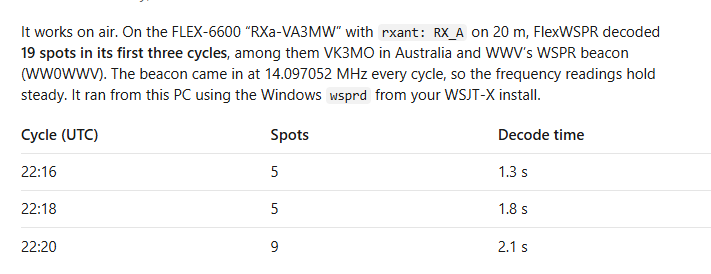
I told it what I wanted. It found the radio on the local LAN and I said make sure you use RXa.
I haven't even seen the user interface yet. (very very scary) :)
 1
-
Thanks, all
I must make the time to get more into Claude. I started to use it to develop a python library for the SmartSDR API. This was back in January when I was in Cyprus. Now that I'm back in the UK, I haven't had the time to finish it off.
To @W2ECK, I do have a dedicated running at the home shack for WSPR research. I was looking for something to run at the remote shack without adding additional kit.
0 -
Mike-VA3MW Administrator, FlexRadio Employee, Community Manager, Super Elmer, Moderator adminOptions
I've got one written. It actually works on windows and should on Debian, but I have yet to test it.
I ran it all night.
I have not generated a release yet, but here it is
73
0 -
Mike-VA3MW Administrator, FlexRadio Employee, Community Manager, Super Elmer, Moderator adminOptions
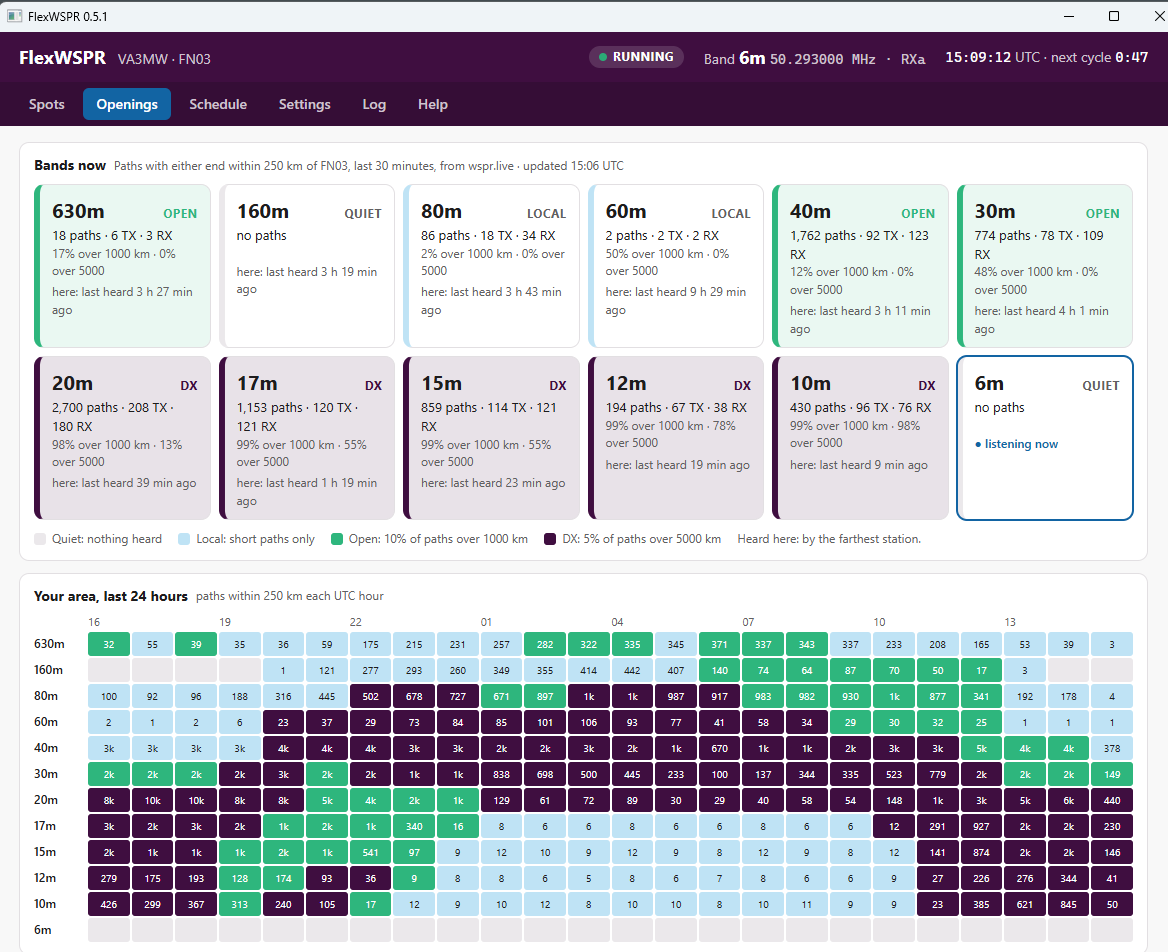
I'm done hacking with it for a while. I'm running it on Windows, but it should run on a PI on the same network.
You do not need to run SmartSDR at the same time.
 0
-
Thanks, @Mike-VA3MW.\
I'll give it a whirl.
0


Leave a Comment
Categories
- All Categories
- 417 Community Topics
- 2.2K New Ideas
- 716 The Flea Market
- 8.7K Software
- 225 SmartSDR+
- 6.6K SmartSDR for Windows
- 212 SmartSDR for Maestro and M models
- 472 SmartSDR for Mac
- 282 SmartSDR for iOS
- 270 SmartSDR CAT
- 225 DAX
- 397 SmartSDR API
- 9.7K Radios and Accessories
- 140 Aurora
- 387 FLEX-8000 Signature Series
- 7.3K FLEX-6000 Signature Series
- 1K Maestro
- 58 FlexControl
- 876 FLEX Series (Legacy) Radios
- 1K Genius Products
- 495 Power Genius XL Amplifier
- 366 Tuner Genius XL
- 139 Antenna Genius
- 333 Shack Infrastructure
- 237 Networking
- 500 Remote Operation (SmartLink)
- 150 Contesting
- 867 Peripherals & Station Integration
- 148 Amateur Radio Interests
- 1.2K Third-Party Software